Despite increasing activity in Earth orbit, space still lacks permanent industrial infrastructure. There are no orbital shipyards capable of constructing kilometer-scale structures, no fully operational propellant depot networks, and no large populations living and working in space. Outside Earth’s atmosphere there exists vacuum, intense radiation, extreme thermal variation, and microgravity—but there are no natural ecosystems, no breathable atmosphere, and no standing supply chains.
Every system necessary for human survival must either be launched from Earth or manufactured in space.
To motivate the rapid development of the first settlement, the Competition assumes a compelling global objective. In this scenario, accelerating climate instability leads the international scientific community to recommend deployment of a space-based solar shield at the Earth–Sun L1 libration point. Studies suggest that reducing incoming solar radiation by less than one percent could stabilize Earth’s climate system. However, a structure capable of producing that effect would need to span an area comparable to that of a large U.S. state and could only be constructed economically in space.
Alexandriat is therefore established as the primary construction and industrial base for building the solar shield.
The urgency of this mission mobilizes resources on a scale rarely seen outside major wartime efforts. Governments, commercial space companies, and research institutions collaborate in an unprecedented global engineering project. Massive investments flow into heavy-lift launch vehicles, cislunar transportation systems, autonomous construction robotics, advanced materials processing, and large-scale orbital manufacturing systems.
The guiding principle behind Alexandriat’s design is simple: functionality first.
The first settlement does not need to be architecturally elegant or optimized for centuries of habitation. Instead, it must satisfy four primary requirements:
- provide safe and psychologically sustainable living conditions for its inhabitants
- achieve operational self-sufficiency in power, life support, and maintenance
- enable large-scale manufacturing and assembly in space
- serve as the logistical and industrial hub for solar shield construction
Anything beyond these objectives is considered secondary during the initial construction phase.
Alexandriat is constructed near the Earth–Moon L5 region, a location that offers long-term gravitational stability and convenient access to both lunar resources and cislunar transportation routes. This region also serves as a natural staging point for materials traveling toward the Earth–Sun L1 region where the solar shield will ultimately be assembled.
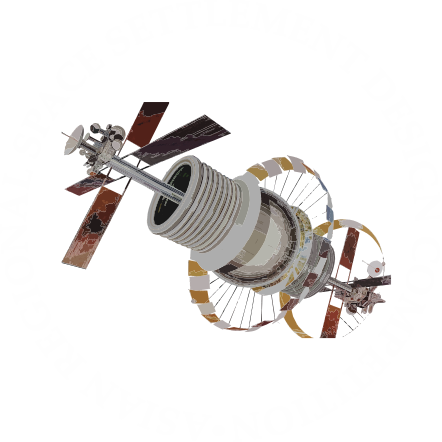
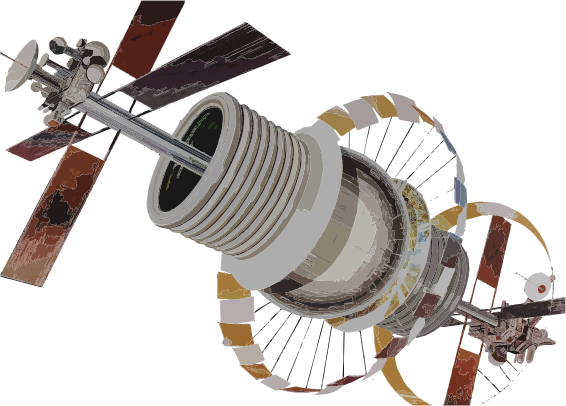
The settlement itself is built as a rotating toroidal habitat connected to a central industrial hub. The rotating ring provides artificial gravity for residents. Artificial gravity is generated through rotation, producing centrifugal acceleration along the outer rim of the habitat. This principle has been studied for decades and is considered essential for long-term human health in space.
The design draws inspiration from earlier habitat studies such as the Stanford Torus, a NASA concept capable of housing approximately 10,000 people within a rotating ring roughly 1.8 kilometers in diameter.
Alexandriat follows a similar architecture but is constructed in modular segments that allow the settlement to expand over time.
The central hub is a non-rotating structure located at the axis of the settlement, that serves as the primary docking complex and industrial core. Spacecraft arriving from Earth, the Moon, and other orbital facilities dock here. The hub contains cargo handling systems, manufacturing facilities, robotics control centers, zero-gravity research laboratories and ship maintenance bays. Zero-gravity manufacturing is particularly valuable for producing specialized materials, optics, and thin-film structures required for the solar shield. A network of spokes connects the hub to the rotating ring. These spokes house elevators and transport vehicles that move personnel and materials between the microgravity hub and the rotating habitat. Because rotational speed is carefully controlled, artificial gravity along the ring is maintained at approximately 0.5 g, sufficient to support long-term human health while reducing structural stresses. The rotating ring forms the main living area of Alexandriat. As the settlement spins, inhabitants experience gravity along the interior surface of the ring. The interior environment resembles a long valley that curves upward on both sides until it meets overhead, forming a continuous circular landscape. Agricultural areas, residential districts, parks, and light industry occupy different sections of the ring. Sunlight is delivered into the habitat through a system of large external mirrors that reflect solar energy into the interior. This concept was first studied in the classic NASA settlement designs of the 1970s and remains an efficient way to illuminate large orbital habitats.
Building Alexandriat within twelve years requires an unconventional construction approach. Transportation from Earth remains expensive even with reusable launch systems, so the settlement relies heavily on extraterrestrial resources, particularly materials derived from the Moon. Early robotic mining operations extract lunar regolith, which is processed into oxygen, metals, ceramics, and structural materials. Oxygen supports life support systems and propellant production, while metals such as aluminum, titanium, and iron provide structural components.
Large quantities of unrefined lunar material are also used as radiation shielding. Shielding mass is one of the largest material requirements for any long-term space habitat.
Construction follows an incremental approach. The first phase establishes a small construction hub and docking complex. From this core structure, trusses and structural frames extend outward. Rotating habitat segments are assembled piece by piece as materials arrive.
Robotic construction systems perform much of the assembly work. Autonomous inspection drones, free-flying construction robots, and tele-operated systems handle repetitive tasks, while human crews supervise integration and perform complex operations. As each new section of the habitat becomes operational, additional residents arrive to expand the settlement’s capabilities.
Although Alexandriat contains residential and agricultural areas, its primary function is industrial. Large manufacturing facilities located near the central hub produce components of the solar shield. The shield itself consists primarily of ultra-thin reflective structures designed to slightly reduce the amount of sunlight reaching Earth.
Because these structures are extremely large but very lightweight, manufacturing them in space avoids the enormous cost of launching them from Earth. Finished shield segments are transported from Alexandriat to the Earth–Sun L1 region using high-efficiency cargo vehicles.
The early population of Alexandriat is small—only a few hundred engineers, technicians, and scientists during the first operational years. Over time, the population grows into the thousands. Agricultural systems inside the rotating habitat rely heavily on hydroponics and controlled environment farming. Crops are selected for high yield and efficient resource use. Recycling systems recover water, oxygen, and nutrients from waste streams with extremely high efficiency.
Daily life combines elements of a frontier industrial outpost and a small self-contained city. Residents live beneath a curved sky of mirrors and sunlight, surrounded by gardens and agricultural fields that provide both food and psychological comfort.
Despite the harsh environment outside the habitat walls, the interior of Alexandriat gradually becomes a stable and livable environment. With sufficient commitment, cooperation, and technological progress, Alexandriat is completed in roughly twelve years. Its completion marks a turning point in human history. For the first time, humanity possesses a permanent industrial foothold beyond Earth. The settlement demonstrates that large-scale construction, manufacturing, and habitation in space are not only possible but practical. The technologies developed for Alexandriat accelerate progress in energy production, materials science, robotics, and environmental engineering on Earth.
More importantly, Alexandriat proves that humanity can build entire worlds where none previously existed. Once that capability exists, the rest of the chronology becomes possible.